Lightheaded Lighting · SESCO line card
Lightheaded Opus — 3-inch recessed downlight
Specified across South Florida. One housing, interchangeable magnetic trims, and the amber engine that answers a turtle ordinance from inside the building.
A 3-inch aperture specification downlight with trims that change after the ceiling is closed. Round or square off the same cutout, adjustable or fixed, 5° to 80° plus wall wash, up to 97 CRI — and an amber engine at 585–595 nm for coastal work.
- 3″ aperture · 2″ pinhole
- 40° tilt · 361° rotation
- Up to 3300 delivered lm
- 2200K–4000K plus warm dim
- Amber 585–595 nm
- Damp listed, wet optional
- Made in Canada
- 5-year warranty

Three pages, one housing
Go straight to your aperture
Every Opus shares the same housing, driver and lumen packages. What changes is the shape of the hole in the ceiling. Each of these pages carries the cutout dimensions, aperture sizes and trim options for that family.
Opus Round
Ø3.875" cutout, Ø3.15" aperture. Deep regress, shallow, wall wash, pinhole and adjustable trims, trimmed or trimless.
Opus Square
Same Ø3.875" cutout, square trim. 2.86" adjustable, 2.9" fixed and 3.04" wall wash apertures, trimmed or trimless.
Opus Multiples
1x2 and 1x3 cells in one plaster frame. 7.9" and 11.56" trimmed, 6.69" and shorter trimless, round or square cells.
Why it lands on a schedule
One housing. Change the trim whenever you like.
Most recessed packages get decided twice — once at design development and again on site, when the reflector finish turns out wrong or the beam is too wide over the island. Opus is built so the second decision does not cost anything.
The trims lock in magnetically and are interchangeable at any point, including after the fixture is installed and the ceiling is closed. Round becomes square. Fixed becomes adjustable. A 40° flood becomes a 10° spot. Round and square trims use the same ceiling cutout, so the shape is not locked in by the drywaller.
On the adjustable trims the cradle tilts 40° vertically and rotates 361°, with a sliding baffle and dust cover that stops anyone seeing up into the housing or the plenum. That is the part that matters in a finished space — an aimed fixture that still reads as a clean aperture from the floor.

Practical version: you can commit to the housing early, keep the aperture and the aiming open until the space is built, and change your mind at punch list without pulling anything out of the ceiling.
The trims
Round and square, fixed and adjustable
Every trim below runs off the same 3-inch housing. Pinhole trims narrow the visible aperture to 2 inches; the pinhole reflector is painted black as standard.
Round adjustable T3RA / T3RYADeep or shallow regress. 40° tilt, 361° rotation.
Round fixed T3RF / T3RYFDeep or shallow regress, no aiming.
Round shallow regress T3RYFShallower cone, softer shadow line.
Round pinhole T3RP / T3RPA2″ aperture, fixed or adjustable.
Square adjustable T3SA / T3SYASame ceiling cutout as the round.
Square fixed T3SF / T3SYFDeep or shallow regress.
Square pinhole T3SPBlack reflector standard.
Square pinhole adjustable T3SPAAimed, aperture still tight.
Wall wash T3RWW / T3SWW20° set tilt, 24″ wall spacing.
Flange types: trimmed, trimless, and wood trimless (TLW) for timber and slat ceilings. A single-piece flange and reflector painted one color is available on the trimmed fixed and adjustable trims.
Finishes: white, black, bronze, matte nickel and matte silver, with custom colors on factory consultation. Flange and reflector can be specified in different finishes — Lightheaded powder coats in house.
Multiples
1x2 and 1x3, in one plaster frame
Where a single aperture will not carry the throw or the design wants a row, Opus is available as a 1x2 or 1x3 multiple. One driver per lamp still applies, so each head is independently driven — and each can carry a different beam spread.

1x2, white Layout 2Two heads, square apertures.
1x3, white Layout 3Three heads in one frame.
1x2, black reflector Layout 2Dual finish — white flange, black cone.
1x3, black reflector Layout 3Reads as a dark slot from below.
Multiples take the square trims — adjustable, fixed, shallow, pinhole and wall wash. Trim layout must match housing layout, so unlike the single-lamp version this is a decision that has to be made at the housing stage rather than at punch list.
Optics
5° to 80°, plus wall wash
Eight beam spreads and a dedicated wall wash module. Beam spread is a field-interchangeable module rather than a fixed part of the fixture, which is the other half of the "decide later" argument — though changing one in the field is a conversation with Lightheaded, not a five-minute job.
| Code | Beam | Typical use | Availability |
|---|---|---|---|
| B05 | 5° | Pinpoint on art, objects, a bar back | 9002 and 9003 lumen series only, 2700/3000/3500K, UNV voltage, P1/P0/D dimming. Not with emergency. |
| B10 | 10° | Tight accent, tall ceilings | 8010, 9008, 8014, 9010. Not in 2200K. |
| B20 | 20° | Accent, feature walls | All series |
| B30 | 30° | General accent | All series |
| B40 | 40° | The default — general downlighting | All series |
| B60 | 60° | Wide, low ceilings, corridors | All series |
| B70 | 70° | Very wide wash | All series |
| B80 | 80° | Widest flood | All series |
| BWW | Wall wash | Grazing and washing vertical surfaces | Must be ordered with a WW trim and WW glass. Not with 8030 or 9023. |

Optional media drops into the light engine to modify the beam without changing the module: softening (SL), frosted (FRO), honeycomb louvre (HC), spread (SPDL) and elongating (EL). Media is available with the OPEN lens option; a clear lens is standard.
Output
Lumen series, CRI and color
Four engine families. Delivered lumens below are per lamp at 3000K on a 40° beam — the numbers to design to, not source lumens.
Standard LED — 80 and 90 CRI
| Series | CRI | Delivered lm | Watts |
|---|---|---|---|
| 9002 | 90 | 200 (11,000 cd) | 8 |
| 9003 | 90 | 260 (14,300 cd) | 11 |
| 8010 / 9008 | 80 / 90 | 1025 / 875 | 9 |
| 8014 / 9010 | 80 / 90 | 1450 / 1225 | 13 |
| 8018 / 9014 | 80 / 90 | 1975 / 1675 | 18 |
| 8023 / 9018 | 80 / 90 | 2625 / 2225 | 25 |
| 8030 / 9023 | 80 / 90 | 3300 / 2850 | 33 |
Premium LED — 97 CRI
SDCM under 2, which is the number that keeps a run of downlights looking like one run. Series 9708 (820 lm, 9 W), 9710 (1100 lm, 13 W), 9714 (1490 lm, 18 W).
Warm dimming — 95 CRI
Series 9510, 925 delivered lumens at 12 W, dimming 3000K down to 1800K along a curve that tracks MR16 halogen. Specified as color temperature 3018.
Premium color — tunable
RGB plus white, or tunable white, at 95 CRI. Tunable color delivers 900 lm at 20 W (9510) or 700 lm at 15 W (9508); tunable white 1050 lm at 20 W or 750 lm at 15 W, across 1800K, 3000K and 6500K sources. DMX personalities are configurable via RDM, including R-G-B-W at a chosen white point, dim-to-warm, and HUE-SAT-INT-CCT.
Static color temperatures: 2200K, 2700K, 3000K, 3500K, 4000K. 2200K is 90 CRI only. Color accuracy is under 3 SDCM on standard, under 2 on premium. L70 is estimated at 50,000 hours across the range.
Turtle code
The amber Opus, and what it clears in South Florida
Why this one is hard to match.
Almost everything sold as turtle-compliant in Florida is exterior — bollards, wall packs, step lights, six-inch commercial cans. When a beachfront condo needs the interior downlights to comply too, because they are visible through the glazing, the usual answer is to swap in something that does not belong in a finished ceiling.
An interior, specification-grade, 3-inch amber downlight at 585–595 nm, in the same trim family as the rest of the ceiling, is genuinely unusual. It means the units facing the ocean can carry the same aperture, the same reflector finish and the same regress as the units facing the street — and the only thing that changes is the engine.
This is the version that makes Opus worth a phone call on a coastal job. Lightheaded publishes an amber LED engine with a dominant wavelength of 585 to 595 nanometers and states it meets Florida wildlife guidelines.
| Series | Delivered lm | Watts | L70 |
|---|---|---|---|
| 0014 | 250 | 8.5 | 50,000 h |
| 0018 | 350 | 12 | 50,000 h |
Why the number matters here. The Florida model ordinance defines long wavelength as 560 nm or greater and absent wavelengths below 560 nm — a two-part test. Palm Beach County goes further and requires greater than 570 nm under ULDC Article 14.A.9.C.1.d. At 585–595 nm the amber Opus sits clear of both.
Two things to be straight about, because they decide submittals:
Broward defines wildlife friendly as a certification, not a wavelength. Sec. 39-112 defines it as fixtures and bulbs certified by the Florida Fish and Wildlife Conservation Commission through the Wildlife Lighting Certification Program. Lightheaded states the amber Opus meets FWC guidelines; that is not the same sentence as an FWC certification listing. On a Broward job in a zone that requires wildlife friendly lighting, confirm the certification status before it goes on the schedule. I will get that answer from the factory rather than guess at it.
2200K is not amber. A 2200K white source is warm, but it still emits across the short end of the spectrum and does not pass the two-part test. If the ordinance is in play you need the amber engine, not a warm white one.
More detail on the rules themselves: sea turtle lighting in South Florida and Broward Sec. 39-112.
An interior, specification-grade, 3-inch amber downlight is genuinely unusual. Most of what gets offered as turtle-compliant is exterior — bollards, wall packs, 6-inch commercial cans. If you have a beachfront condo, a lanai ceiling or a unit with glazing in line of sight of the beach, this is a real answer rather than a compromise.
Housings
Plenum depth, insulation and Chicago
The housing is ordered separately from the luminaire and can ship ahead of it, which is how you keep a ceiling on program when the trim finish is still being argued about.
| Housing | Depth | Notes |
|---|---|---|
| Opus non-insulated | 4.82″ (122 mm) | Standard depth |
| Opus Shallow non-insulated | 2.75″ (70 mm) | For tight plenums |
| Opus insulated | 5.8″ (147 mm) | IC airtight |
| Opus Shallow insulated | 2.75″ (70 mm) | IC in a shallow plenum |
Ceiling options are non-insulated (F), insulated airtight (IC) and Chicago Plenum (CP). IC and CP are UL2043 rated enclosures suitable for installation in air handling plenums. Neither IC nor CP is available with the 8023, 8030, 9018 or 9023 lumen series.
Ambient temperature: rated to 40°C (104°F) in insulated ceilings and 45°C (113°F) in non-insulated. Worth checking against an unconditioned attic or a soffit in July.
Mounting: flag-style feet handle ceiling thickness from 1/16″ to 1 1/4″ as standard, with a thick ceiling kit available beyond that. Housing shape must match trim shape, and trim layout must match housing layout on multiples.
Location rating: damp location listed as standard, with wet location optional. On a covered lanai or an exterior soffit — which in this market is most jobs — specify the wet option rather than assuming the damp listing covers it.
Controls
Dimming, and getting it right the first time
One driver per lamp. The protocol has to match the controls package that is already bought, and on Opus the voltage you pick constrains which protocols you can have — that is the trap on this fixture.
| Code | Protocol | Floor | Voltage |
|---|---|---|---|
| S | Phase | 1% | 120V only |
| P | 0-10V | 1% | UNV 120–277V, and the only option at 347V |
| P1 | 0-10V eldoLED ECOdrive | 1% | UNV |
| P0 | 0-10V eldoLED SOLOdrive | 0.1% | UNV |
| D | DALI-2 eldoLED ECOdrive | 1% | UNV |
| LH | Lutron Hi-lume EcoSystem, soft-on fade-to-black | 1% | UNV |
Read this before you order. 120V is phase dimming only. UNV covers P, P1, P0, D and LH. 347V is 0-10V only, and is not available trimless with the remodel driver. The 8030 and 9023 series are S and P dimming only. Get the voltage and the protocol agreed together, not separately.
Lutron Athena Wireless Node is available for individual wireless fixture control — in P (0-10V) or D (DALI-2) dimming, trimmed flange, non-insulated housing only. Consult the factory on availability with the emergency battery options.
Phase dimmer compatibility is published across Lutron (Diva, Ariadni, Skylark, Skylark Contour, Lumea, Dalia, Nova T, Maestro, Sunnata, Caseta, RadioRA2, RadioRA3, Homeworks and QSX), Control4 and others, split by forward-phase, reverse-phase and phase-adaptive. The full list is in the compatibility sheet below — check the exact model number, not just the family.
Emergency: EM1 (integral test switch) and EM2 (remote test switch and cover) provide 7 watts of emergency power for a minimum of 90 minutes. Not available at 347V, and not with remodel LH dimming or with IC/CP housings on a remodel driver.
Documents
Spec sheets, IES files and install instructions
Everything a specifier or an estimator normally has to email someone for. Take it straight off the page.
- Standard LED specificationPDF · 3.9 MB · single, multiples, trimmed, trimless and wood trimless order forms
- Premium LED (97 CRI) specificationPDF · 3.6 MB
- Amber LED specificationPDF · 3.5 MB · 585–595 nm, spectral power distribution
- Premium Color LED specificationPDF · 3.2 MB · tunable color and tunable white, DMX personalities
- Standard LED IES filesZIP · 7.1 MB · short form first, then straight to the download
- Premium LED IES filesZIP · 1.2 MB · short form first
- Dimming compatibilityPDF · dimmer model numbers by manufacturer and type
- Housing install instructionsPDF · 2.5 MB
- Trim install instructionsPDF · 1.4 MB
The IES libraries are organized by trim family — T3RA, T3RF, T3RP, T3RPA, T3RWW and the square equivalents — then by beam spread and lumen series, with adjustable trims given at both 0° and 40° tilt. If your designer wants a specific file rather than the whole library, tell me the catalog number and I will send it across.
Photometrics
Get the Opus IES files
Four boxes, then the download page. I ask because I would rather know a layout is being built than find out at submittal — and if the line changes, I can tell you instead of leaving you with a stale file.
See it work
Opus in a finished space
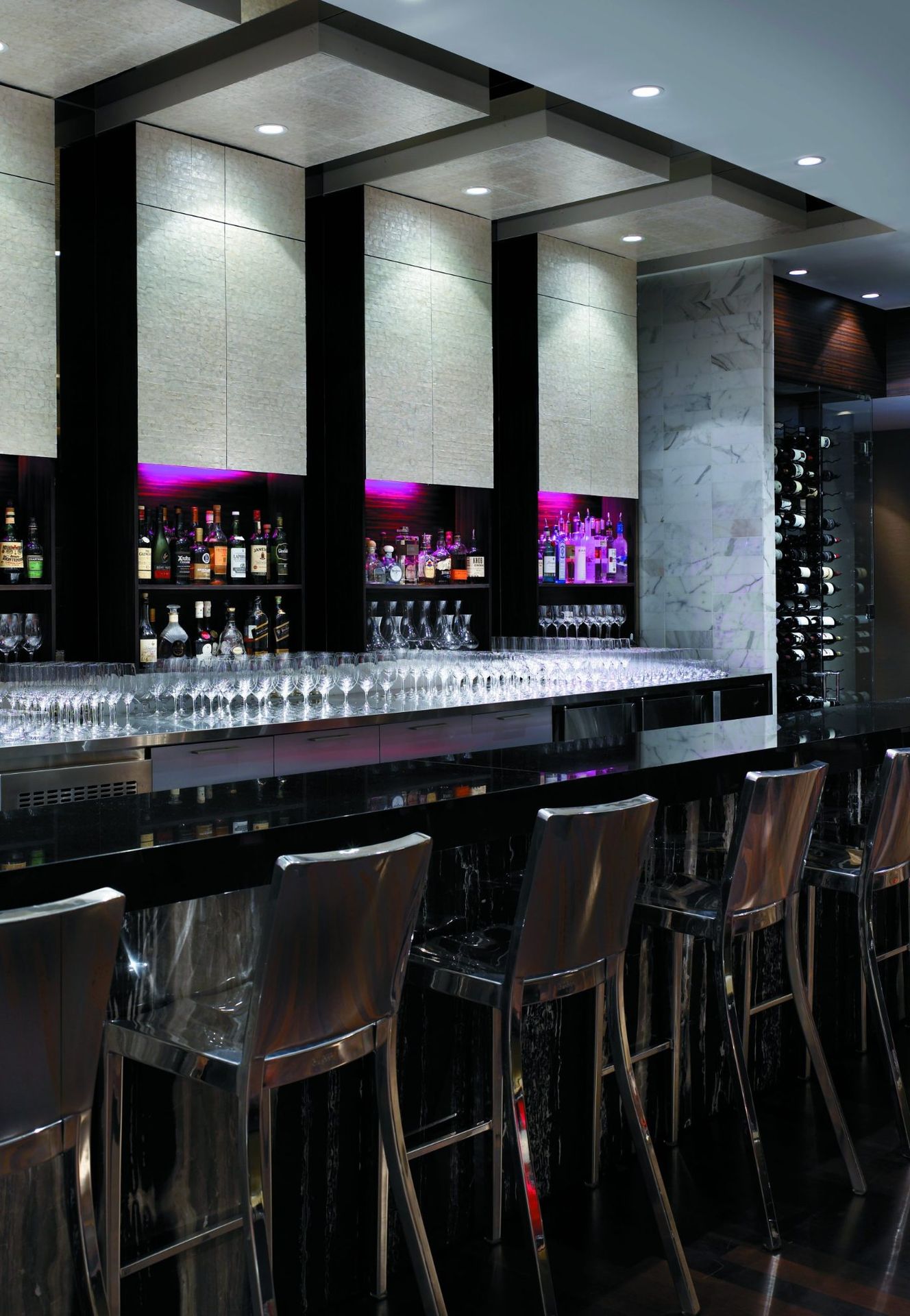


Where it earns its place in this market: hotel lobbies and bars where the aperture has to disappear, timber and slat ceilings where the wood trimless flange matters, covered terraces and lanais where the wet option and the corrosion question both come up, and high-end residential where the client will notice a 97 CRI source against an 80 CRI one on stone and on skin.
Common questions
Questions I get about Opus
Who is the Lightheaded Lighting rep in South Florida?
I am. Lightheaded is on the SESCO line card I represent across Miami-Dade, Broward, Palm Beach, Martin, St. Lucie, Indian River, Okeechobee and Monroe. Send the fixture schedule or the reflected ceiling plan and I will price it, get samples in front of you and stay on it through submittal. 786-395-1222.
Can one housing take round, square and multiple trims?
Round and square trims use the same ceiling cutout, so you can change between them at any point — including after installation, because the trims lock in magnetically. Multiples are different: trim layout must match housing layout, so a 1x2 or 1x3 has to be decided at the housing stage.
Is 2200K the same as turtle-safe amber?
No, and this catches people. 2200K is a warm white source that still emits below 560 nanometers, so it fails the two-part long-wavelength test in the Florida model ordinance. The amber Opus engine is a different product with a dominant wavelength of 585 to 595 nanometers.
Do recessed downlights on a Florida beachfront job have to be amber?
It depends on the jurisdiction and on whether the fixture is visible from the beach, directly, indirectly or cumulatively — including interior fixtures seen through glazing. Palm Beach County requires greater than 570 nm, the state model says 560 nm, and Broward defines wildlife friendly as FWC-certified rather than by wavelength. Check the city ordinance first, then the county.
What is the difference between trimmed, trimless and wood trimless?
A trimmed fixture has a visible flange sitting on the ceiling. Trimless is plastered in so the aperture reads as a hole in the ceiling with no visible edge, which needs to be coordinated with the drywall contractor before the ceiling closes. Wood trimless (TLW) is the same idea detailed for timber and slat ceilings.
Do I need Chicago Plenum housings in Florida?
Usually not. Chicago Plenum is a specific requirement that comes from Chicago-area code. What you may well need here is the UL2043 rating for installation in an air handling plenum, which both the IC and CP options carry. Ask your engineer which one the drawings actually call for before you pay for CP.
Which dimming protocol should I specify?
Whichever one the controls package already uses — that decision is usually made before the fixtures are. If it is Lutron, LH gives you Hi-lume EcoSystem with soft-on fade-to-black. If the job is DALI, D gets you DALI-2. If you need to go below 1%, P0 with the eldoLED SOLOdrive reaches 0.1%. The constraint to watch is voltage: 120V is phase only, 347V is 0-10V only.
How do I get the IES files and spec sheets?
They are on this page — the standard and premium IES libraries, all four specification sheets, the dimming compatibility list and both install instruction sets. No form, no email. If you need a specific file rather than the whole library, send me the catalog number.
Is Opus rated for a covered lanai or an exterior soffit?
Damp location is standard and wet location is an option, so the answer is yes with the wet option specified. Do not assume the damp listing covers an exposed soffit. On coastal work also raise the finish question with me, because salt air is a separate problem from water ingress.
Where is it made, and what is the warranty?
Made in Canada, with a five-year warranty. Lightheaded powder coats trim finishes in house, which is why dual-finish flange and reflector combinations are straightforward rather than a special.
Next step
Get Opus on your job
Send the fixture schedule, the reflected ceiling plan, or just the type you are trying to solve. No charge for a takeoff. I will come back with pricing, lead time, the right catalog numbers, and the two or three configuration constraints that would otherwise bite at submittal.
Samples are worth asking for on this one. The trim change is the kind of thing a designer believes when it is in their hand.
Ask about Opus · Lightheaded Lighting line page · More recessed lighting · See the full line card